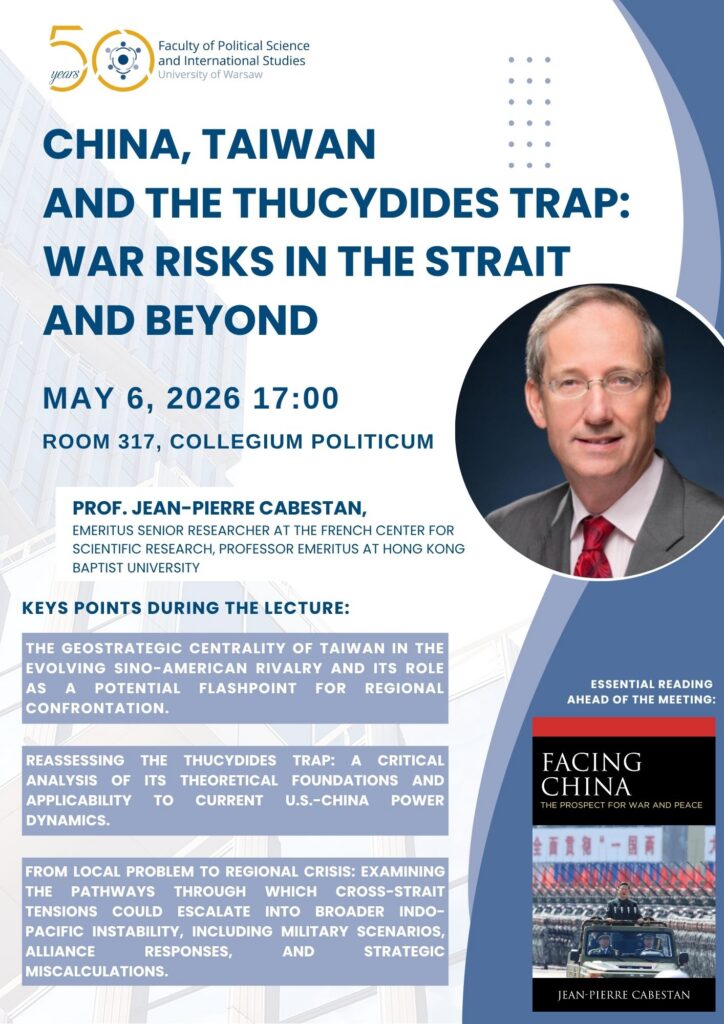
We cordially invite you to a guest lecture by Professor Jean-Pierre Cabestan, a distinguished French scholar and leading expert on Chinese foreign policy, Taiwan, and international relations in Asia. Throughout his long academic career, which has included positions at the French National Center for Scientific Research and Hong Kong Baptist University, among others, Prof. Cabestan has made significant contributions to our understanding of the Chinese political system, the country’s strategic ambitions, and its evolving position on the international stage. His latest publication (in French) is a biography of Deng Xiaoping.
Professor Cabestan is also the author of the monograph “Facing China: The Prospect for War and Peace,” in which he critically analyzes Graham Allison’s concept of the “Thucydides Trap” regarding the inevitability of conflict between an existing hegemon and its potential successor (the second global power). In his publication, Professor Cabestan attempts to answer the questions: Does China’s rise pose a threat to the United States? Could this lead to war between the two countries?
We recommend familiarizing yourself with the book “Facing China: The Prospect for War and Peace” before the lecture, although it is not mandatory.
The lecture (in English) will take place on May 6, 2026, at 5:00 PM in room 317 of the Auditorium Building.
Key issues to be discussed during the meeting:
· Taiwan’s geostrategic importance in the context of growing Sino-American rivalry and its role as a potential flashpoint for global conflict
· A Conceptual Assessment of the “Thucydides Trap”: A Critical Analysis of Its Theoretical Foundations and Application to the Current Dynamics of U.S.-China Relations
· From a local problem to a global crisis: an analysis of scenarios (including military ones) that could cause tensions between the PRC and Taiwan to severely disrupt stability in the Indo–Pacific region, potential responses from allies on both sides, and the risks of strategic errors in assessing the situation.
We cordially invite you!