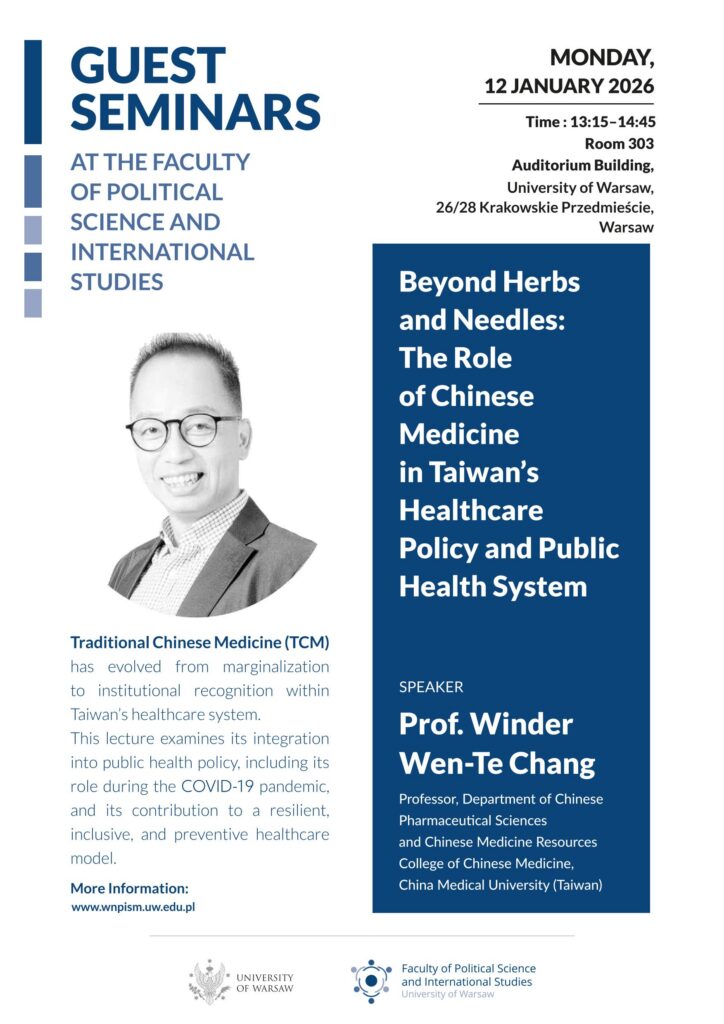
Seminar on the Role of Traditional Chinese Medicine in Taiwanese Health Policy
We invite you to a seminar on the role of traditional Chinese medicine in Taiwanese health policy, which will take place on Monday, January 12, 2026, from 1:15 PM to 2:45 PM, in room 303 in the Auditorium Building of WNPiSM UW.
Although Western medicine continues to dominate Taiwan’s healthcare system, traditional Chinese medicine (TCM) has evolved from historical marginalization to political integration and institutional recognition. Its role in public health has become increasingly prominent thanks to its inclusion in the National Health Insurance (NHI) system and its participation in long-term care programs. During the COVID-19 pandemic, the government-approved Qingguan No. 1 formula (NRICM101, RespireAid) demonstrated TCM’s contribution to prevention, symptom relief, and recovery from infection, underscoring its value in epidemic control.
This lecture will trace the development of TCM within Taiwan’s healthcare system and public health policy, from plague prevention during the colonial era to contemporary health management. It argues that the institutionalization of TCM not only preserves an important cultural heritage but also enhances the resilience and inclusivity of Taiwan’s healthcare system. By combining traditional wisdom with contemporary policy frameworks, TCM continues to play a vital role in promoting holistic and preventive healthcare for Taiwan’s aging and diverse population.
Prof. Winder Wen-Te Chang is a professor in the Department of Chinese Pharmaceutical Sciences and Chinese Medicine Resources at the College of Chinese Medicine at China Medical University in Taiwan. He also serves as deputy curator of the Lifu Museum of Chinese Medicine. He is currently the head of the Department of Taiwan Studies at Leiden University in the Netherlands.