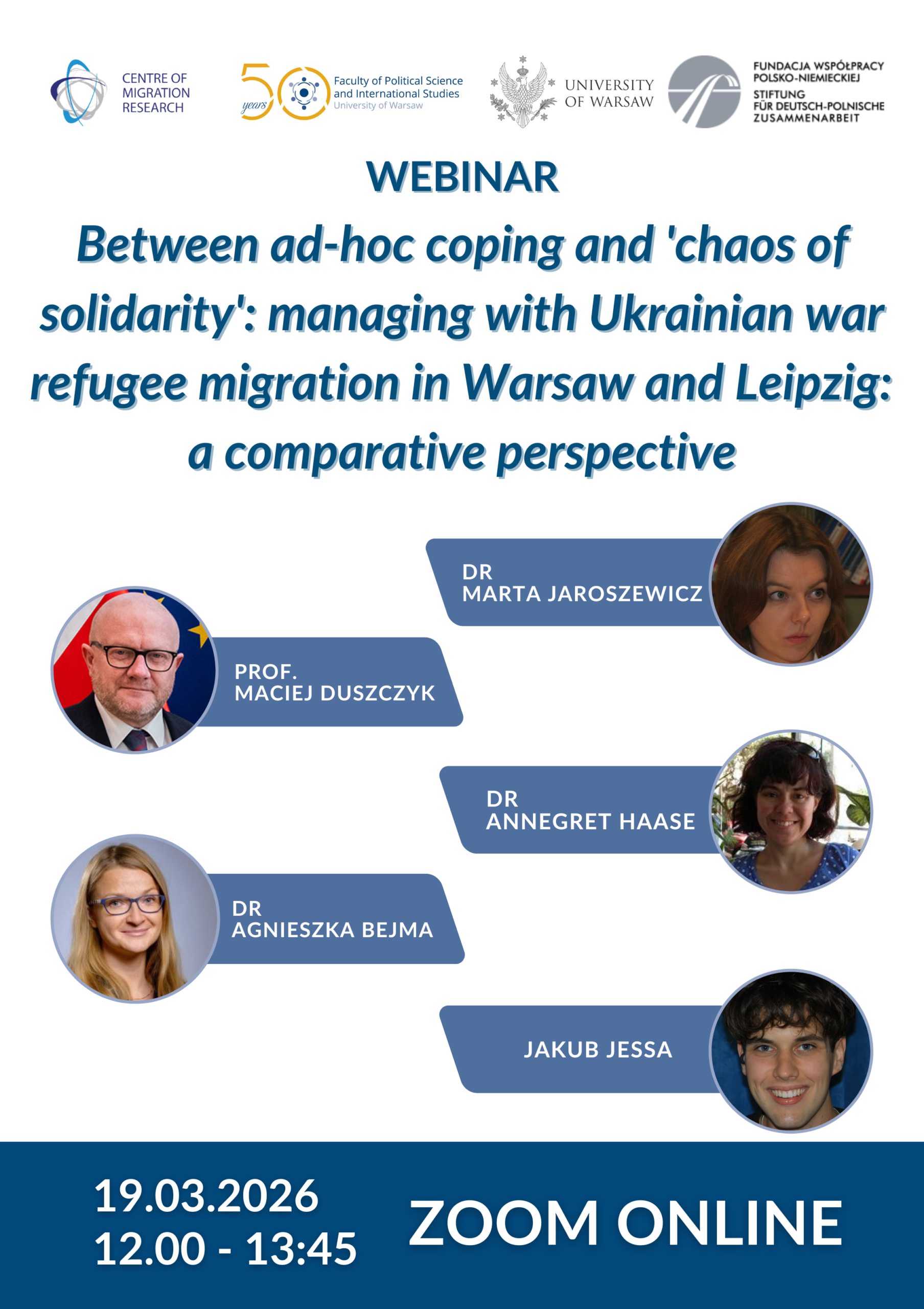
Webinar: From Ad Hoc Solutions to the “Chaos of Solidarity”: Managing the Migration of Ukrainian War Refugees in Warsaw and Leipzig: A Comparative Perspective
Russia’s full-scale invasion of Ukraine resulted in a record number of refugees seeking asylum in EU member states. Poland, Germany, and the Czech Republic became the main destination countries. The first six months were crucial for analyzing the response of public institutions and civil society, particularly in providing refugees with accommodation, healthcare, and education for their children.
Our findings are the direct result of over a year of collaboration between Polish and German researchers, united by the goal of understanding and comparing the responses of two major cities: Warsaw and Leipzig to the mass influx of people seeking shelter in the first months of the crisis in 2022.
The research project, funded by a grant from the Polish-German Foundation for Science, was carried out by two academic institutions: the University of Warsaw in Poland and the Helmholtz Centre for Environmental Research – UFZ in Leipzig, Germany.
Drawing on extensive research, including document and media analysis, as well as qualitative interviews with experts and stakeholders, our project aims to document this unique moment and explain the social mechanisms that shaped Warsaw’s and Leipzig’s institutional and civic response to this unexpected and rapidly evolving challenge.
During the seminar, we will present a clear, research-based account of how public institutions and civil society responded to the sudden, mass influx of refugees. Our intention is to demonstrate the limitations and strengths of state capacity under extreme pressure, while highlighting how grassroots mobilization can complement and even replace formal support systems.
Due to the recommendations it contains for public institutions and civil society organizations, the results of our project may also help prepare national and local authorities for humanitarian crises related to refugee influx. Our research also takes into account the EU perspective and EU law in this area, particularly with regard to temporary protection.
Schedule
12:00 Introduction to the topic and presentation of participants (5 min) – Marta Jaroszewicz
12:05 Project presentation – Maciej Duszczyk (5 min)
12:10 Presentation of the conceptual and methodological framework and
research findings on Leipzig – Annegret Haase (20 min)
12:30 Presentation of research findings on Warsaw – Agnieszka Bejma, Jakub Jessa (20 min)
12:50 Questions and answers + discussion with participants (50 min)
13:40 Summary (5 min) – Maciej Duszczyk, Annegret Haase
Centre of Migration Research in Warsaw
Thursday, 19 March, 12:00–13:45
https://uw-edu-pl.zoom.us/j/92269094360?pwd=xqOMVCsRzqKwpjpSbZ19CIKBtOiHbx.1