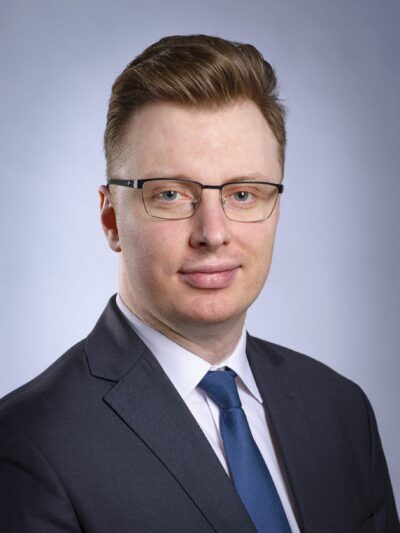
Dr. Michał Szczegielniak – administrator and political scientist, member of the Advisory Group on Social Research at the Chancellery of the Prime Minister (since 2022) and the Council for Senior Citizens’ Policy (since 2024), civil servant, Ph.D. in social sciences with a focus on political science and public administration (2023). Graduate of the Institute of Political Science at the University of Warsaw—specialization: political marketing and consulting—and the Kozminski University—specialization: government administration. Member of the European Consortium for Political Research and the Polish Society for European Studies. Member of the editorial board of the journal “European Review” since 2014. Expert at the Ministry of Family, Labor, and Social Policy (since 2022), the National Institute of Freedom – Center for the Development of Civil Society (since 2020), the “Stocznia” Workshop for Social Research and Innovation as part of the “Active Citizens” program — National Fund (2020–2021) and the Education for Democracy Foundation as part of the “Active Citizens” program — Regional Fund (2021–2022). Participant and organizer of numerous conferences and academic events—including the international academic symposium titled “The Civil Service in Poland—20 Years of Experience and Prospects for Change” and the international academic conference titled “100 Years of the Polish Civil Service.” Former member of the Executive Board of the University of Warsaw Doctoral Student Council, the Faculty Council for Doctoral Students, the Scholarship Appeals Committee, and the Disciplinary Committee for Undergraduate and Doctoral Students. Winner of the 2018 “Academic Debut – Sustainable Development” competition in the master’s degree category, organized by the State Higher Vocational School in Racibórz, the Department of Organization and Management at the Silesian University of Technology, and the Silesian Center for Business Ethics and Sustainable Development.
Research Interests
Public administration within the state’s political system; the state in the face of demographic challenges related to an aging population; the right to information and its limitations; local government and local politics; civil society in the age of the information revolution; relations between the state and the Church.