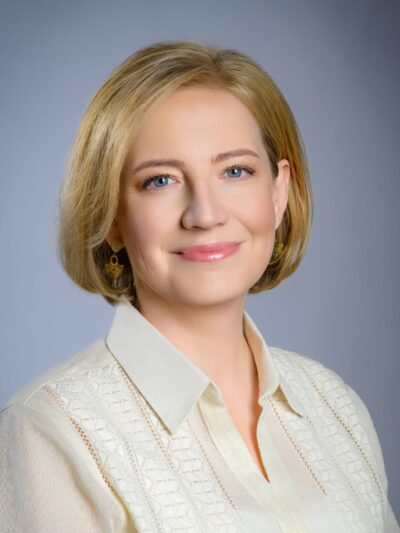
Hanna Schreiber, Ph.D., Professor – Since 2006, she has been a lecturer and researcher at the University of Warsaw; she holds master’s degrees in political science (2005, with honors), law (2006, with honors), and art history (2010). In 2012, she earned her Ph.D. in the humanities, and in 2020, she received her habilitation in the social sciences. In the spring of 2022 and the fall of 2023, she was a fellow at the Ostrom Workshop (Indiana University in Bloomington) and at the University of Pennsylvania. Since 2024, she has been the director of the UNESCO Chair on Intangible Cultural Heritage in Public and Global Governance. For more information: hannaschreiber.com and ichgovernance.com.
She is the principal investigator of a research project funded by the National Science Center: SONATA 15, No. 2019/35/D/HS5/04247, research project title: Between World Heritage and Humanity’s Heritage: Research on International Heritage Management Systems from the Perspective of Elinor Ostrom’s Institutional Analysis and Development (IAD) Model, https://projekty.ncn.gov.pl/index.php?projekt_id=462528. She is also a team member (researcher) on another grant awarded by the National Science Center: OPUS 18, Legal Forms of Heritage Management in Europe (2020–2023); project director: Dr. Andrzej Jakubowski.
Since October 2022, she has served as a mentor under the Polonez BIS grant—a fellowship program for experienced researchers, co-funded by the European Commission and the National Science Center as part of the Marie Skłodowska-Curie COFUND grant. The project for which Dr. Iuliia Eremenko received the grant is titled: “Local Experts in Polish and German Cities Listed as World Heritage Sites: Their Role in the Polycentric Management of Cultural Heritage Sites.”
Hanna currently serves as chair of the Council for the Intangible Cultural Heritage of the Capital City of Warsaw (since February 2020), a position to which she was appointed by the mayor, and is also a member of the Team for Intangible Cultural Heritage of Kraków, established in December 2023. She was the lead coordinator and co-author, appointed by the Ministry of Culture and National Heritage of Poland, for Poland’s first nomination to UNESCO’s Representative List of the Intangible Cultural Heritage of Humanity (the tradition of the Christmasnativity scene in Kraków, inscribed on the list in 2018). She was a member and vice-chair of the National Council for Intangible Cultural Heritage (ICH) in Poland, as well as chair of the Working Group on Legal and Strategic Aspects of ICH Protection within that council (2013–2018). From 2018 to 2022, she served as co-coordinator of the Network of Researchers on Intangible Cultural Heritage (within the Association for Critical Heritage Studies).
Hanna was a member of the official Polish delegations to the sessions of the General Assembly (GA) and the Intergovernmental Committee (COM) under the 2003 UNESCO Convention, which were held in France (General Assembly 2016, General Assembly 2018), in Ethiopia (Intergovernmental Committee 2016), Korea (Intergovernmental Committee 2017), in Mauritius (Intergovernmental Committee 2018), and in Sri Lanka (Intergovernmental Committee 2021—online). She represented her university and a UNESCO-accredited nongovernmental organization—the Association of Folk Artists—in Colombia (COM 2019), in Jamaica (COM 2020—online), in Morocco (COM 2022), in Botswana (2023), as well as at the General Assemblies in 2020, 2022, and 2024 in France.
She was invited by UNESCO as an independent expert to participate in discussions and in the drafting of the “Ethical Principles for the Safeguarding of the Intangible Cultural Heritage” (adopted in 2015), the World Atlas of Languages (expert opinion on legal aspects, 2017), principles and methods for the safeguarding of intangible cultural heritage in emergency situations (adopted in 2019), the reform of the inscription mechanism under the 2003 Convention (adopted as amendments to the Operational Guidelines for the 2003 Convention during the 2022 General Assembly).
He is actively involved in the work of five international organizations: the Forum of Non-Governmental Organizations for Intangible Cultural Heritage (a forum of NGOs accredited by UNESCO), the Association for Critical Studies in Cultural Heritage (ACHS), the European Society of International Law (ESIL), the International Law Association (ILA), the International Society for Ethnology and Folklore (SIEF), and in the activities of three national academic NGOs (the Association of Folk Artists, the Polish Association for International Studies, For All Moonkind—an American NGO).
Speaker, organizer, and participant in international conferences, workshops, and seminars on culture and cultural heritage held in Hungary, Greece, Spain, the Netherlands, Germany, Norway, Belgium, Italy, the United Kingdom, France, Russia, Latvia, South Korea, China, Mauritius, Morocco, India, Bulgaria, Albania, Slovenia, Colombia, Botswana, and the United States.
Research Interests
An interdisciplinary approach to the management of intangible cultural heritage, institutional analysis, and the methodology and concepts of Elinor Ostrom (polycentric governance, common-pool resources, collective action dilemmas), participation in global cultural governance, sociology and anthropology of international relations.