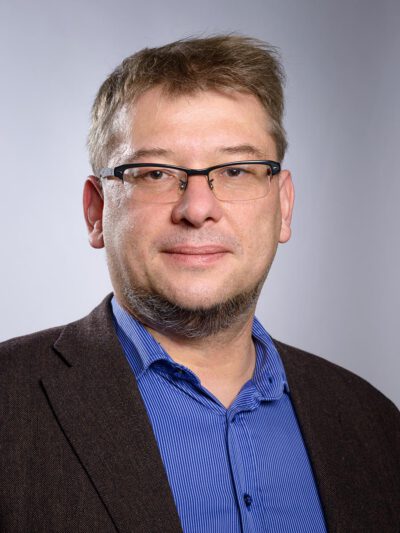
Piotr Załęski, Ph.D., Prof. – Habilitated Doctor in Political Science (2013, University of Warsaw), Ph.D. in Ethnology (2009, Adam Mickiewicz University), Ph.D. in political science (2006, University of Warsaw), M.A. in political and social sciences (1999, University of Warsaw), and holds a postgraduate diploma in ethnology (2005, Nicolaus Copernicus University in Toruń) and in educational management (2001, Podlasie University in Siedlce). He is a researcher and works as an assistant professor at the Faculty of Political Science and International Relations at the University of Warsaw.
In 2020, he was elected to the Faculty Council. Previously, at the University of Warsaw, he served as a member of the Teaching Council at the Faculty of Political Science and International Relations (2020), head of the Eurasian Studies program at the Institute of Political Science (2015–2018), the Institute of Political Science director’s representative for the “Eurasian Studies” program and its implementation (2014–2016), Head of the Political Culture Workshop at the Institute of Political Science (2010–2016), Editor of the “Culture and Politics” series published by the Institute of Political Science (2012–2015), and finally, coordinator for teacher education at the Faculty of Journalism and Political Science (2005–2010).
Since 2011, he has been responsible for coordinating the high school graduation exam in social studies at the Central Examination Board, and since 2019, he has been a collaborator at the Center for Educational Development (the“Teacher’s Handbook” in the field of social studies). Previously, he coordinated the work of a team of experts at the Ministry of Education and Science tasked with easing the requirements for the high school graduation exam in social studies in connection with remote learning (2020) and a team of experts at the Ministry of National Education tasked with developing the social studies curriculum for general education (2016–2019). He served as a collaborator on the regional examination boards in Jaworzno and Łomża and authored draft questions for the external social studies exam (2013–2020). From 2013 to 2015, he led the social studies team as part of an ESF project aimed at creating a question bank for the nationwide external exam. From 2013 to 2014, he served as academic secretary of the Central Committee of the Knowledge of Poland and the Contemporary World Olympiad, and from 1997 to 2007, he worked as a teacher of social studies and other subjects in the humanities and social sciences at various secondary schools (high schools, high schools for adults, vocational schools, and middle schools). He contributed to the development of social studies textbooks in 2002 and 2005, as well as textbooks on the basics of entrepreneurship in 2003. In 2016, he was awarded the Medal of the National Education Commission for outstanding contributions to the field of education and upbringing.
He was the project director of the research project “Traditional Political Culture: Informal Social Ties as the Basis for Social and Political Values, Attitudes, and Political Behavior in Kyrgyzstan in the Context of Central Asia” (2009–2011 ; Ministry of Science and Higher Education), as well as the principal investigator of the project “Ethnopolitical Determinants of the Functioning of the Political Elite in Central Asia” (2007–2008 ; Ministry of Science and Higher Education; principal investigator: T. Bodio; the monograph resulting from this project received an honorable mention from the rector of the University of Warsaw). From 2009 to 2010, he served as a reviewer of grant proposals for the Ministry of Science and Higher Education, and from 2011 to 2021, he was an expert supervising three doctoral grants from the National Science Center; In addition, he served as the advisor to two doctoral students in the field of political science (and public administration).
He has participated in numerous “unsolicited” international research programs, including as project director of “Identity and Historical Memory in Central Asia” (2012–2014), co-director of the project “Kyrgyzstan: Cultural and Sociopolitical Issues” (2009–2011), and as a participant in the “Contemporary Central Asia” project (1999–2009; director: T. Bodio). From 2012 to 2016, he served as deputy editor-in-chief of the quarterly “Society and Politics: An Educational Journal,” which at that time was a joint project of the Academy of Humanities in Pułtusk and the University of Humanities in Bishkek.
In addition, he served as a research fellow at the Institute of Philosophy and Political-Legal Studies of the National Academy of Sciences of the Kyrgyz Republic (senior researcher from 2008 to 2012, head from 2012–2018), and as a visiting professor at the Academy of Public Administration under the President of the Kyrgyz Republic (UNESCO Chair on Democracy in a Multi-Ethnic and Multicultural Society, 2010–2011). He was a member of the Polish Ethnological Society, the Polish Society for Educational Diagnostics, and the European Society for Central Asian Studies. Most of the international conferences he attended over the past five years took place in Poland and Kyrgyzstan.
Research Interests
Political culture in Poland and Central Asia, representations of Central Asia in public discourse and the discourse of Asian elites, issues of historical memory in Poland and the post-Soviet states, cultural identities and intercultural relations in Eurasia, the history of political institutions in Central Asia and the ruling elites of Central Asia, political socialization and civic education, state education policy and educational assessment.